Posts


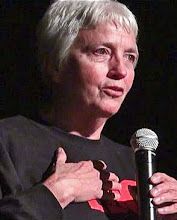
I’m a nomad-by-choice. For the past 10
years, under the banner of HEAR US Inc., my nonprofit organization, I’ve
traveled over 200,000 miles of mostly backroads travel chronicling homeless
families and youth across the country. I live full-time in a van converted into
a motorhome/workspace. I used to run the largest shelter in Illinois outside
Chicago. I’ve been working on the issue of homelessness for 3 decades.

Last night I relented and paid for a campground in Asheville, NC
instead of sleeping in my van in the ubiquitous Walmart parking lot because
temps were down to 20 and I don’t like to freeze. One of my neighbors,
I learned today, was a homeless family staying there because they have nowhere
to go. Their school-age children were on the bus and off to school before I
stuck my nose outside.
Last night in this funky and wonderful western NC city, motels
provided some semblance of shelter for dozens of families who use up their
meager earnings to keep a roof over their heads. Others cobbled together a spot
on the couch or begged for an empty corner in someone’s basement so they
could stay warm and safe.
The meager family shelter options don’t begin to meet the
needs of hundreds of families and youth in the county in need of assistance. I
learned of one mother, a former school social worker whose loss of housing
kicked her and her 8-year-old son to the street. The challenging conditions at
the local rescue mission are too stressful for the boy, so he’s
staying at a children’s emergency shelter while his mom
bunks at the mission.
Family and youth shelter options in Asheville, as with most
communities, are horrifically inadequate, forcing homeless families and youth
to desperately turn to makeshift options, typically on a night-by-night, or
less, basis. But they’re
not “homeless enough” to meet HUD’s standard of
homelessness according to Amy Hobson, program coordinator at Trinity Place, a
local emergency shelter for kids on their own.
During this, the last week of January, the US Department of
Housing and Urban Development, HUD, has mandated that communities across the
land send out teams of social workers and volunteers, armed with clipboards, to
count homeless persons. The diligent effort of these census-takers does not
make up for serious failures on the part of HUD when it comes to addressing
homelessness because they don’t count the bulk of their community’s
homeless population—the invisible families and youth that
desperately need HUD’s housing assistance.
Last year, HUD reported 578,424
homeless persons, an alleged 11% reduction since 2007. Their count chillingly
ignores millions of homeless persons, including babies and toddlers.
The US Department of Education’s (DOE) 2012-13
report indicates 1,258,182 identified homeless
students (not including younger/older siblings or parents), a
whopping 85% increase since the 2006-07 school year. Even worse, a recent report, America’s
Youngest Outcasts, states that the number of homeless children/youth
exceeds 2.5 million (not including parents or single adults). My official HEAR
US estimate is 3 million.
HUD maintains their narrow definition of homelessness, the hallmark
of their fizzled-out 10 Year Plan To End Homelessness. The Baltimore Sun editorial
opines, “The central principle of the city's 10-year plan to end homelessness
was that it would prioritize finding housing first and services second for
those living on the streets. Events like today's clean-up are a reminder of
just how far we remain from realizing that promise.”
HUD’s “point-in-time” count
skips millions of vulnerable children, youth and adults, a potentially deadly
omission. “HUD’s policy excludes
children and youth who face real harm, including negative emotional,
educational, and health outcomes; it also increases their risk of physical and
sexual abuse and trafficking,” according to the coalition pushing for
the expanded definition of homelessness, Help Homeless Kids Now.
This confused, grossly under-counted data gets presented to
Congress, perpetuating the lack adequate funding to address housing needs of
millions of people with nowhere to go.
HUD’s dismal failures include:
1.
“Homeless” to HUD means staying in a shelter
or living on the streets. If you lost housing due to crisis and can’t get into a shelter, and you
turn to family, friends, acquaintances or motels, you're not considered
homeless no matter how fragile those arrangements are.
2.
HUD demands proof of homelessness (yup, you’ve
gotta prove you're deserving of the shelter bed). Such proof might mean an
eviction notice, or a letter from a landlord, or your mother-in-law’s note that explains that she
kicked you and your kids out. Pity the person who cannot document their
situation.
3.
HUD makes it confusing and time consuming for
both the shelter provider and the shelter seeker when it comes to proving
homelessness (see the chart beginning pg. 3 of this PDF doc). “Arbitrary and unworkably burdensome
eligibility rules” now govern our homeless shelter system. It
doesn't matter if you’ve
got the most desperate family sitting in front of you, HUD’s rules rule.
4.
If you’re
a vulnerable (think sex trafficking, sex-for-bed, gang-bait, etc.) homeless
youth on your own, but not seen sleeping in an alley, HUD won’t count you. One of the main
reasons we have such an abysmal system for serving youth on their own who are
homeless is because HUD’s
definition of homelessness doesn’t
include them, so they’re
not counted.
5.
If you’re
a family that’s
scotch-taped together a flimsy plan to stay with family, friends or acquaintances
after you lost housing (doubled up video, Worn Out Welcome Mat),
HUD won’t count you.
Christine Craft, the Homeless Education Liaison for Buncombe County Schools,
told me that 75% of the students she serves don’t fall under the HUD definition, doubling or tripling up in
many cases.
6.
If you’re
a family staying in a motel on your own thin dime because you have nowhere to
go, HUD won’t count you.
Most of the families that Ms. Craft works with have someone working, but the
motels eat up most of their meager pay, giving them no option to save for a
security deposit to move out.
7.
HUD pits single adults against families and
youth by forcing communities to prioritize adults in order to get funding.
While HUD pays lip service to serving families (not so much youth), their
funding decisions tell the story.
The dire realities most people don’t know until they
experience homelessness: Many communities don’t have shelters.
Some shelters turn away boys in families, don’t accept intact
families, same-sex parents, those with criminal records, substance users, or
parents with work schedules conflicting with shelter curfews.
First Focus, a children’s advocacy group, estimates over 1 million homeless children and youth are
ineligible for HUD assistance because of not being homeless enough to satisfy
HUD guidelines.
And HUD continues to push “Housing First,” a
way to pop people into housing and then offer services to help them., although
HUD has shifted away from funding services. Housing First was used mostly for
those deemed “chronically homeless” by HUD’s parlance with
mixed results. Even this approach is doomed,
with funding a major issue, hello Congress! And HUD’s one-size-fits-all
approach to homelessness doesn’t work, as this short video by the Institute of Children, Poverty and Homelessness points out.
Especially in light of the latest blizzards and Arctic cold
spells, people of compassion would like to think that the federal agency
charged with housing the housing-challenged, especially families and youth, was
under control. Not so. But hope is on the horizon!
Bipartisan legislation aimed at expanding HUD’s definition of
homelessness has been introduced, with growing support making it likely that
soon HUD will have to face the brutal reality that they need to help millions
of kids and adults with nowhere to go.
To help homeless kids, urge your lawmakers to pass the new(old) legislation simply by going to www.helphomelesskidsnow.org and sign the petition. Takes just seconds!
If nothing else, HUD is guilty of a big logic FAIL. How do you
justify claiming reduced homelessness in
light of a shattered economy, massive foreclosures and evictions, slashed
affordable housing stock, pathetic wages for the bulk of the working class,
inadequate health care and child care, and more? Oh yeah, just don’t
count them.